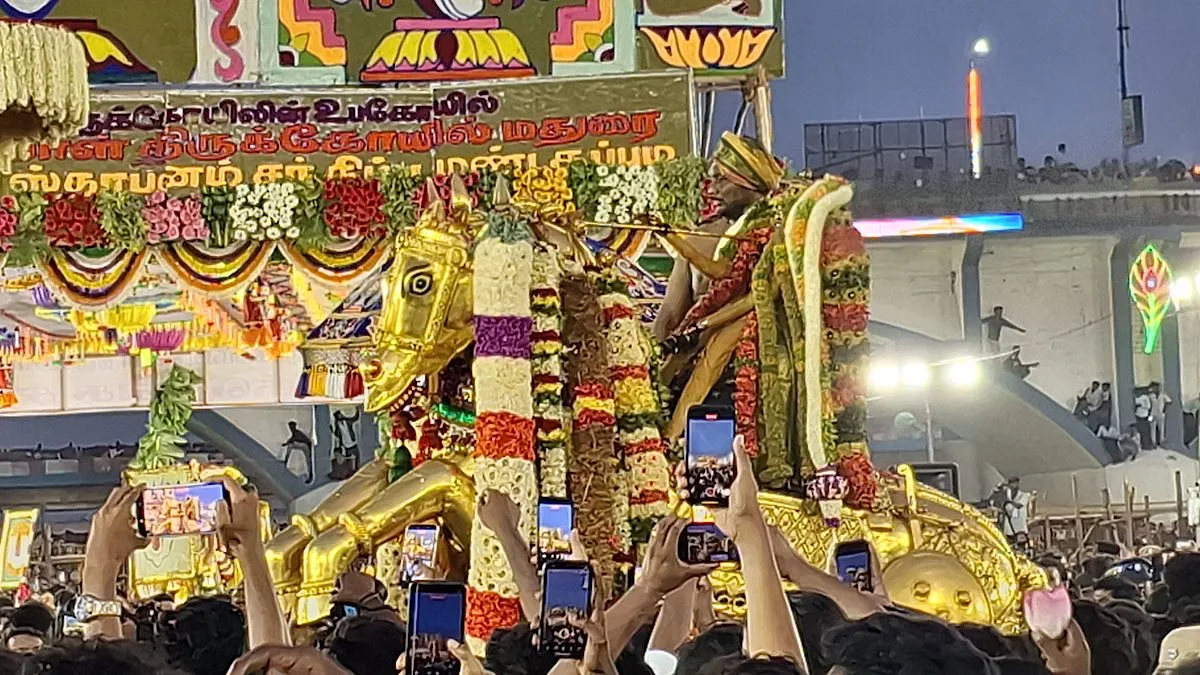
It is a divine rendezvous! He is the lord is the lord of the masses, an entertainer mingling with his devotees, who throng not just to have a glimpse of him but engage in celebration. For, he is the god who makes an effort to reach out to his faithful that takes him on a 42 km trip, up and down from his abode on an idyllic hillock, Azhagarmalai, to the river Vaigai in Madurai.
In the long journey enroute, Lord Sundararaja Perumal dons the robes of the dominant local community, the OBC Kallars, and hence the nomenclature ‘Kallazhagar’, which is indicative of Vaishnavite classical tradition accommodating folk customs and tradition in its expansion and consolidation. The lord finds mention in Sangam poetry and the temple, though an ‘Agama’ temple, devotees relish feasting on animal sacrifice.
Advertisement
As the divine mingles with the masses, becoming one among them, expression of devotion takes a rustic flavour with devotees in thousands, young and the old, dressed in the attire of the lord and traditional music bands, singing and the valour and exploits of the deity, are among the multitude who enliven the atmosphere.
From Dalits to OBCs and so-called upper castes of the region, every community is accorded temple honours during the annual festival, the Madurai Chithirai festival, the crescendo of which is the lord stepping into the waters of Vaigai on the full moon Day of the Tamil month Chithirai. It witnesses a sea of humanity, converging on the northern banks of the river, making it the Kumbh Mela of Tamil Nadu, sans monks.
Along the 21 km route, travelled by the lord in a golden horse on a palanquin from his abode in the serene Azhagarmalai, he is received with traditional gaiety. In Madurai city alone, he steps in to bless the devotees at nearly 500 ‘Mandagapadis’, stations. On arriving in the city the previous day after the celestial wedding of goddess Meenakshi with lord Sundareswarar, he stays overnight and it has a popular narrative associated with it that of Azhagar visiting his lady love, Thuluka Nachiyar, a Muslim woman.
The history and tradition of the temple, important among the 108 Divya Desams of Sri Vaishnavism, reveals layers of accommodation with the local communities. Besides assuming the name ‘Kallazhagar’, the processional deity sports the attire distinctive to the Kallars as well as their hairstyle and wields ‘valari’, a native boomerang. He changes this dress code once entering Madurai and returns to it after exiting the city.
And, according to researchers, this is part of a social contract to ensure security for the temple as the community is numerically dominant in the area. Moreover, the temple entrance has the folk deity ‘Karuppasamy’, the personal guard of the lord, whose shrine is none other than a huge sword at the side of the main door of the temple which remains closed forever and devotees enter the precincts through an adjacent entrance.
“Innate beauty in black,” is how the lord is sung in the Sangam literature. Lest, we come to the conclusion that the deity is owned by the Kallars, other communities are not left out. “All the communities are accorded equal temple honours with the ceremonial turban at the festival. Further, it is the local Zamindar of Velliyankundram who sees off Azhagar before his journey to Madurai, a tradition unbroken for 33 generations,” says Ramasamy Bhattar of the temple.
On Friday, he stepped into the river donning green silk attire, signifying copious rain for this season.